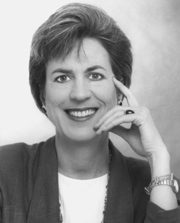
Mariah Burton Nelson
Sexual exploitation and forgiveness
My mother is a psychiatrist, so I'm comfortable here, among mental health
professionals, which is a good thing, because I'm going to be discussing
a somewhat uncomfortable issue: sexual abuse. I'll tell you the story
of a teenage girl who was molested by her swimming coach for three years,
beginning when she was 14 and he was 25. This is a common phenomenon in
sports, unfortunately. An athlete trusts, respects, and looks up to her
coach, who takes advantage of her youth and naivete.
The girl was, of course, me. It's a distressing story but fortunately
there's a happy ending: forgiveness. I know that many of you have patients
for whom forgiveness is a significant therapeutic issue. And I would suspect
that for some of you, self-forgiveness might be an important part of your
work -- since, like all of us, surely you make mistakes at least occasionally!
The sexual abuse part of this story begins when my coach, a handsome
and charming man I'll call Bruce, praised my writing, supported my passion
for sports, gave me posters and poetry, and, while I sat frozen in fear
and confusion on the car seat next to him, eased his hand inside my sweatpants.
I felt deeply flattered, horribly ashamed, guilty, infatuated, scared,
and, because he was married, brokenhearted.
Bruce called this "an affair" and complimented me on being "mature enough
to handle it." He introduced me to the term "statutory rape," explaining
that "other people wouldn't understand -- especially your parents," and
warning me that if I told anyone, he would go to prison.
I didn't start dealing with the effects of this exploitation until about
20 years later, when I wrote about the widespread problem of coach-athlete
abuse in my book, The Stronger Women Get, The More Men Love Football.
I didn't identify Bruce in the book, but wrote about my experience with
him. After the book came out, I changed my mind about shielding Bruce's
identity, and started naming him in public presentations. Though I was
not consciously vengeful, one might reasonably interpret my "outing" him
as an expression of revenge. Soon someone in my audience reported the
situation to his supervisor. Shortly after that, I received a call from
Bruce. He asked me to forgive him.
Wary and angry, I refused, accusing him of trying to manipulate me into
silence. But he persisted, writing me two letters in which he apologized
for hurting me and requested "some sort of peace or reconciliation between
us."
I remained wary, but eventually it occurred to me: What if I never forgive
him? At age forty, was I facing another forty years of bitterness over
something that had happened in my teens? The wound was not healing on
its own. I thought, Something has to give. Then I thought, Maybe that
something is me.
I called Bruce, and we talked for an hour. Over the next six months,
we talked on the phone many times, exchanged many long letters, and met
in person twice.
Ultimately I did forgive him. The process of forgiving him changed me.
I was not only released from decades of anger about Bruce, I became a
more loving, forgiving, emotionally generous person toward myself and
others. My story is not unique; in The Unburdened Heart, I offer dozens
of stories of people who have become free through forgiveness. I also
offer five original keys to forgiveness and freedom:
1) Awareness: Remember who hurt you and how.
2) Validation: Talk to a sympathetic listener.
3) Compassion: Strive to see the offender's humanity.
4) Humility: Reflect on your own mistakes and limitations.
5) Self-Forgiveness: Open your heart to yourself.
Forgiveness frees people from the grudges and anger of the past. It
frees us from attachment to the person who wounded us, and from the identity
of victim or martyr. Forgivers become free to love more, and to receive
more love.
You are in the business of helping people understand the past and unburden
their hearts. I hope you will continue to explore the healing power of
forgiveness with your patients, and in your own lives. **
Bio:
Mariah Burton Nelson, a former Stanford and professional basketball
player, has written three books about women, men, and sports, including
Embracing Victory: Life Lessons in Competition and Compassion (William
Morrow), and The Unburdened Heart: Five Keys to Forgiveness and Freedom
(HarperSanFrancisco). A former weekly columnist for the Washington Post,
she now writes columns for Oxygen Media on their WeSweat.com
website, and gives customized speeches to about thirty groups each year.
Links: MariahBurtonNelson.com
Email: Mariah@MariahBurtonNelson.com
|